How My Calendy Works
Six steps from sign-in to a week that fits your brain
Demo Video Coming Soon
Our video walkthrough is currently being produced. Check back soon!

Sign in with Google. Your calendar comes along.
One click with your Google account; we never see your password
We read busy and free times only, never event titles or attendees
The Hub, your profile and your timeline are open to explore straight away
Planning your first project starts the 7 days free, no card
Pro Tip
Sign in with the Google account whose calendar you actually use. Busy times from that calendar are what the planner works around.
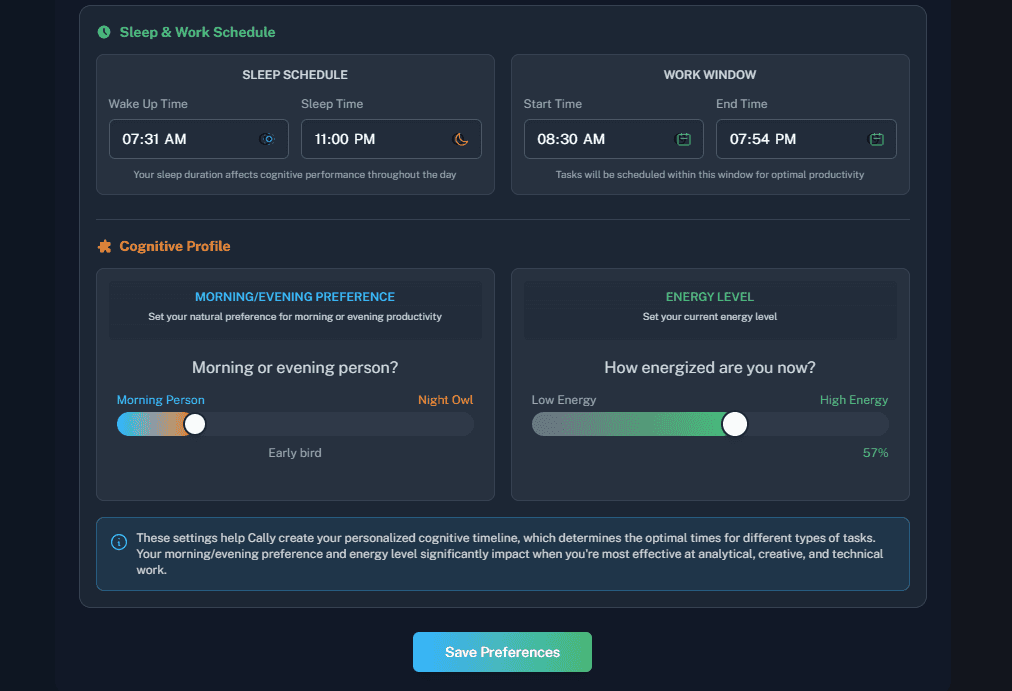
Four answers describe your day.
Wake time, bedtime, and the hours you work
Whether mornings or evenings are your stronger half
Your usual energy, as a starting point the check-in adjusts daily
Change any of it in Settings; the timeline updates at once
Pro Tip
Answer for a normal week, not an ideal one. The morning check-in handles the days that are different.
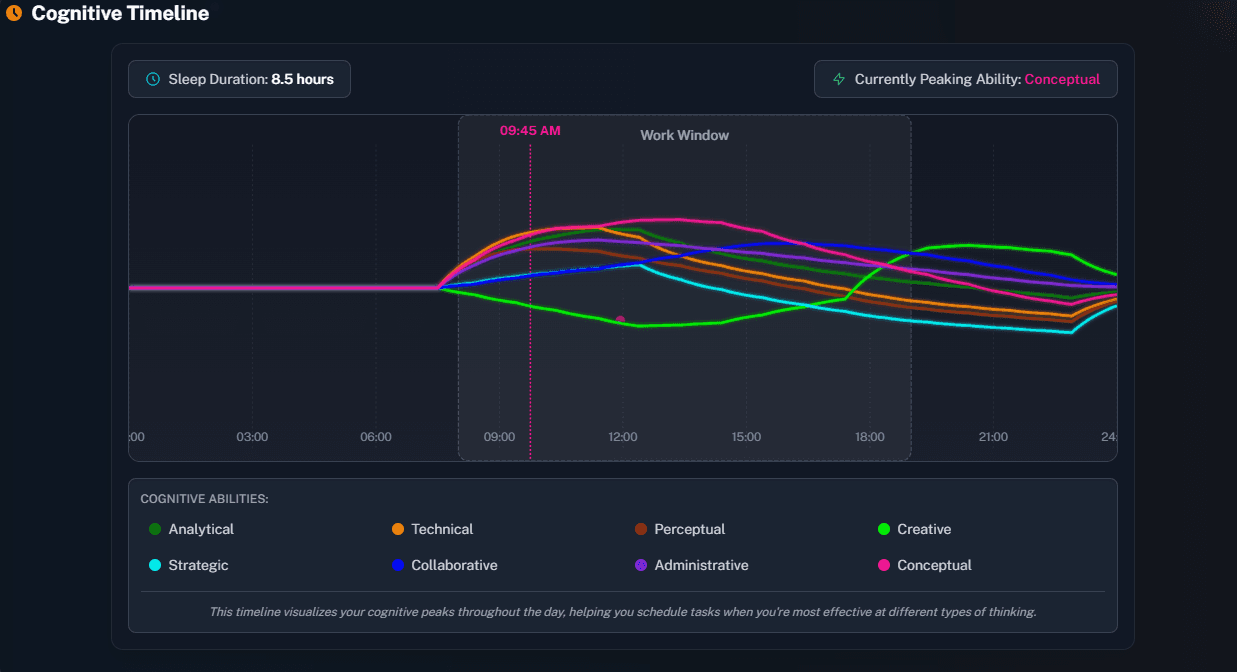
Eight abilities, hour by hour.
Analytical, Technical, Perceptual, Creative, Strategic, Collaborative, Administrative, Conceptual
Each curve comes from chronobiology research listed on Sources, shaped by your answers
Read it as a starting point: timing effects are real but not universal
Your own check-ins and feedback refine it over time
Pro Tip
Notice which abilities peak when. That alone is useful for the work you schedule by hand.
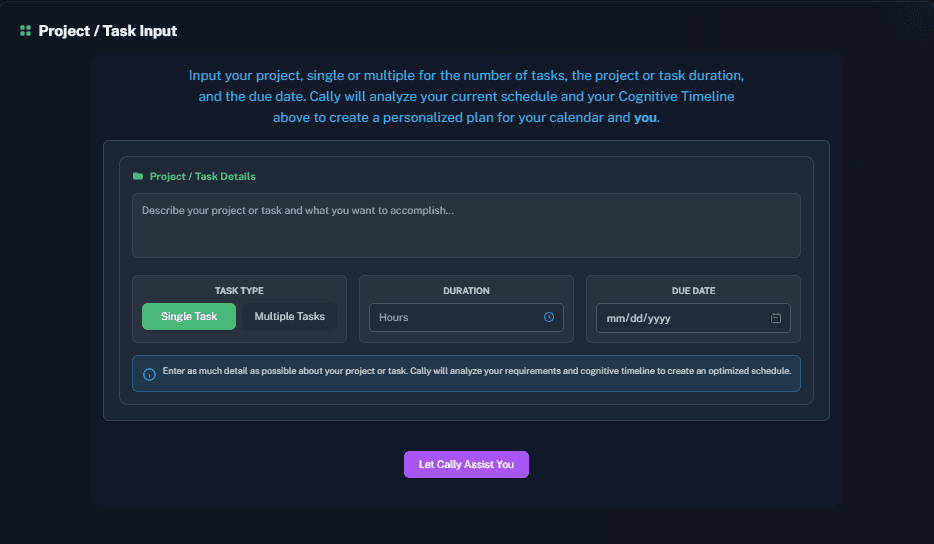
Describe it. Give it hours and a date.
AI breaks the brief into milestones, phases and real tasks with estimates and dependencies
Each task carries the one ability it needs most
The planner places the sequence across the days before your due date, each block in that ability's window
It works around what is already on your calendar
Pro Tip
Two or three sentences with the deliverable, the audience and the constraints give the planner enough to build real tasks.
A block slipped. Press once.
A 20-second morning check-in on sleep and energy reshapes the day
The Hub shows what to do right now and what is next
When a block slips, moves, is done partially or skipped, the rest of the project is re-planned in order
You get a plain note on what is done, what remains and whether the deadline holds; undo or pin anything
Pro Tip
The match percentage on each block is the planner's estimate of how well that hour suits that ability. Pin the blocks that must not move; let the rest flex.
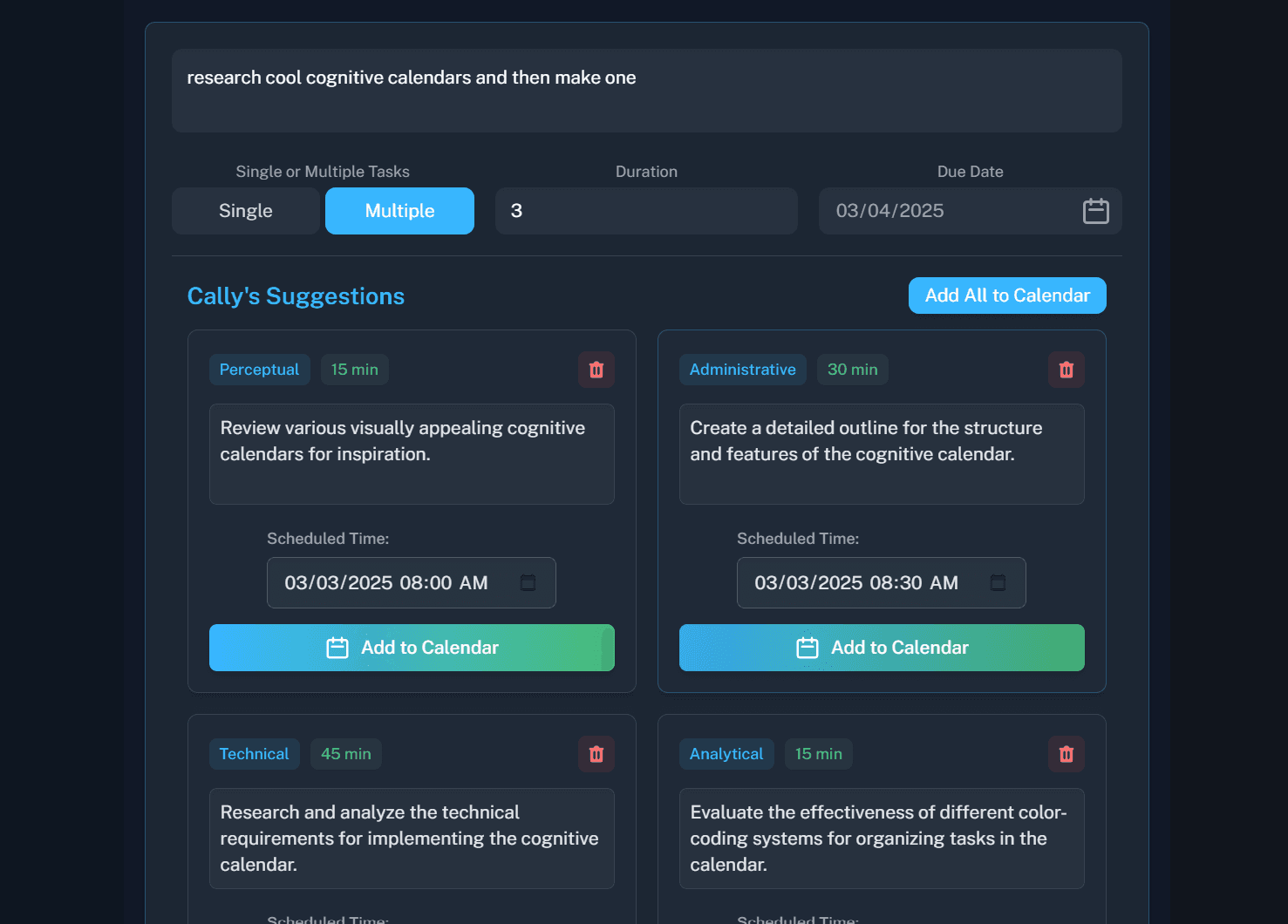
Blocks land where you already look.
Add a whole project to Google Calendar in one press; moves are written back
Subscribe from Apple Calendar, Outlook or any app with the ICS feed in Settings
Share a public page of your peak hours: working hours and ability names, nothing else
On Peak, invite your team for a privacy-safe cognitive map, meeting windows and assignment by ability
Pro Tip
If you live in Apple Calendar or Outlook, subscribe to the ICS feed once and forget about it. It refreshes as the plan changes.
Frequently Asked Questions
Everything you need to know about My Calendy
Busy and free times, so blocks are placed around your day, and the events it creates itself, so it can move them when it re-plans. Event titles, descriptions, attendees and locations are never stored.
Yes. Wake, sleep, work hours and your morning or evening preference live in Settings. Change any of them and the timeline updates at once; the next re-plan uses the new curve.
Your profile produces an hour-by-hour curve for eight abilities from chronobiology research listed on Sources. The morning check-in adjusts the day for sleep and energy, and your feedback on finished blocks refines the curve over time. Timing effects are real but not universal.
The Hub is a responsive web app, and your blocks appear in Google Calendar or, through the ICS feed, in Apple Calendar, Outlook or any calendar app on any device.
Nothing, unless you decide to continue. The trial takes no card. If you add one, Flow is $9 a month or $75 a year and Peak is $19 a month or $158 a year, and you can cancel any time from Settings.
Plan one project and see the difference.
7 days free. No card. Your first plan takes about a minute.